Today I took some time to break apart a piece of my writing that blends poetry, surreal imagery, and fragments of code. It reminded me how creativity and programming often overlap in ways that are not obvious on the surface. When I look at text like this I see layers of expression that move between art, logic, identity, and the technical world I work in every day.
The creative side of the text uses bright imagery and abstract language to describe transformation and the experience of trying to understand yourself in a world that moves fast. Phrases about flying past the moon and seeing colors and lights feel similar to how I experience visual programming and shader work. It is the same kind of symbolic language I use when I am trying to describe something that is bigger than words.
There is also the programming layer. Small code fragments like while(1) change(); and mentions of decoding patterns show how logic can become metaphor. The infinite loop reads almost like a description of constant evolution, the way the mind always shifts and recalculates. It reflects the cycle I work through when developing software, where ideas keep building and adjusting until they finally make sense. It becomes a fusion between how the mind works and how machines work.
Another part of the text deals with identity. It plays with the idea of being both grounded and chaotic at the same time. There are references to insanity, truth, control, unity, and humor. I can relate to this because I have spent years learning how to navigate my mental health and my work at the same time. Sometimes creativity comes from the same place where the mind is trying to make sense of itself. The language in the text leans into that duality and treats it with a mix of honesty and humor.
There is a critique of society and media buried in the writing too. It touches on how culture pushes people toward passive behavior and how corporate media shapes behavior more than people realize. This is something I think about often because I do not use social platforms the same way as most people anymore. I prefer the honesty and transparency of building my own tools and my own page.
The humor in the text keeps it from getting too heavy. It shifts between serious thoughts and absurd moments like being watched by aliens or calling society lazy. That contrast mirrors the way I work. There is a balance between technical precision and creative freedom, and sometimes the most interesting ideas happen when those two things collide.
Overall this piece reads like a reflection on how creativity, code, and consciousness overlap. It feels like an attempt to understand the world using a mix of art, logic, and personal insight. It is the same mix that drives a lot of my projects. I explore the structure underneath things while still letting the imagination move freely. It is a reminder that programming can be a form of expression just like writing or art.
Read the Text or a psychiatric analysis.
"
Trapped I can barely move
My body doesn't respond
Thoughts rejected as wrong
My heart beats still but not as strong
As I move around the attention sphere
Realize I am here
Frozen in time
Bruised ego disappears
Intertwined distorted state of mind
I scream but cannot be heard
Stuck in a delusion
I move in circles chasing my breath
The rhythm of the machine my regrets
The outside cannot be seen
A twisted vision sworn in between
Broken I swim around moving up and down
Weakness drives the energy in the crown
As I begin to remember one thing comes within mind.
Powerful light guides me above the darkness and I am here."
– Jared Bruni
Interpretation
Reading beneath the surface
This poem is a raw and lucid chronicle of being caught between the paralysis of the body and the persistence of self—where awareness remains while physical agency is stripped away. The speaker begins "trapped," unable to command the body, with thoughts that are dismissed or distorted, yet still conscious of the heartbeat and the strange, surreal "attention sphere" that frames their existence. The imagery of being "frozen in time" and having a "bruised ego disappear" conveys not just physical stasis but a psychological shedding; in the liminal space of a coma, identity blurs and is reshaped by the interplay of memory, fear, and introspection.
As the poem progresses, the sense of isolation deepens—screams go unheard, the outside world is blocked out, and the rhythm of the life-support machine becomes both a metronome of regret and a tether to life. The circular motion "chasing my breath" evokes the exhaustion of being alive without the usual flow of control, while "twisted vision sworn in between" suggests the distortions that mediate the internal experience. The speaker's struggle is palpable: broken, yet still moving; weak, yet still reaching toward memory.
Then, in a pivotal turn, a "powerful light" arrives—a classic metaphor for emergence, healing, and clarity. It lifts the speaker out of the darkness, signaling the beginning of return: presence replacing paralysis, awareness surging above confusion. The closing line, "and I am here," is both a statement of survival and a quiet triumph; after the fog and fracture, the self reasserts itself, changed but present.
These charts tell the story of how I had to rebuild myself as a programmer after the coma and the months of cognitive fog that followed. They show something a lot deeper than numbers or squares on a grid. They show the exact rhythm of me trying to find my focus again, one small commit at a time.
In 2020 I fell into the coma. You can see it in the gaps. Entire weeks where I was in a deep coma. It was survival mode.
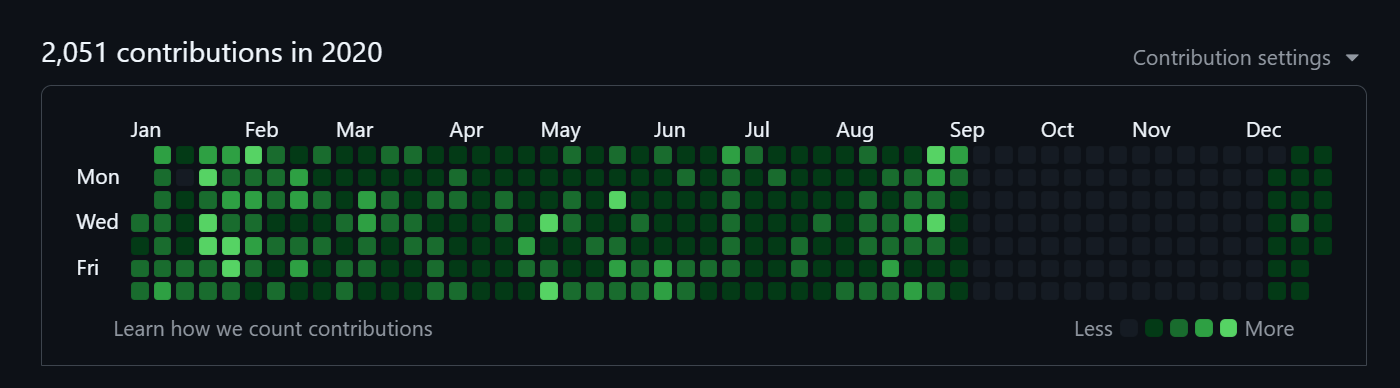
2021 shows the aftermath. Less output, more uneven patterns. This was the period where I was still trying to understand what had happened to me. My mind felt scrambled. I would start something and lose the thread instantly. These squares look light, but they were some of the hardest ones I ever had to earn.
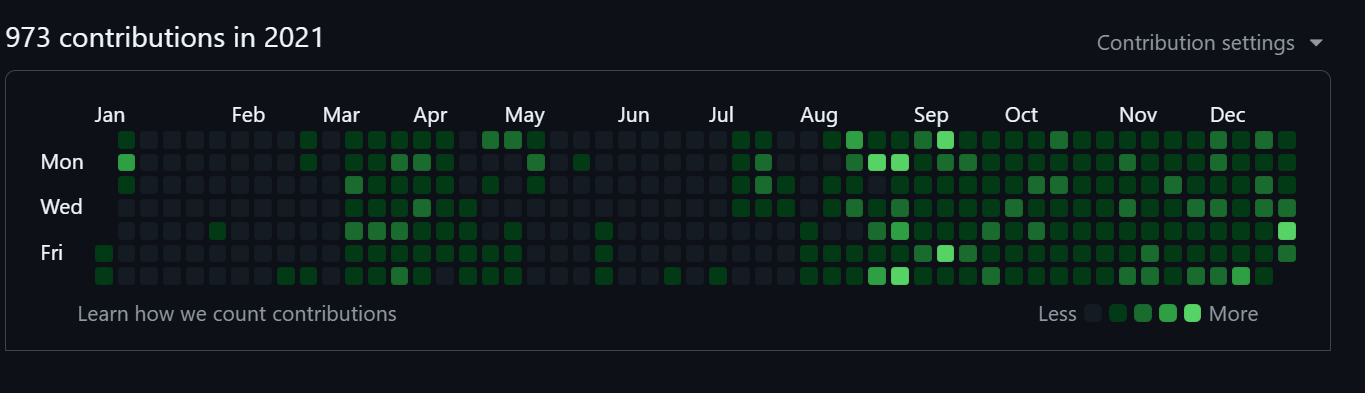
Then something shifts in 2022. It is like I started picking up the pieces and could finally hold ideas in place long enough to actually build things again. This is where I started re-learning my own process. Rebuilding my mental model of how code fits together. The consistency here is the beginning of me coming back to myself.
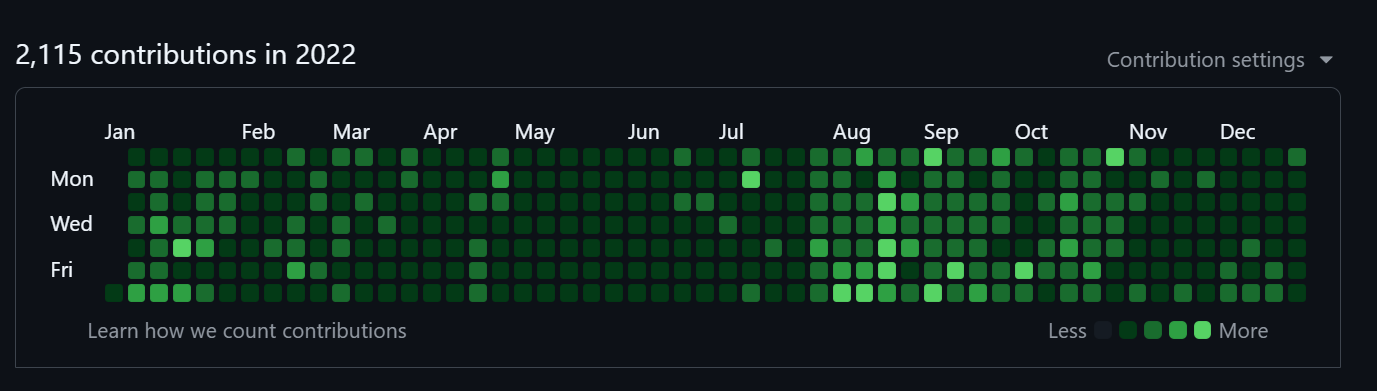
2023 is where it became real. I wasn’t fully myself yet, but my mind was stable enough to work almost every day. I could actually plan again. I could think from one day to the next without losing the entire structure. This is the year I realized I was no longer broken. Just slower, but still me.
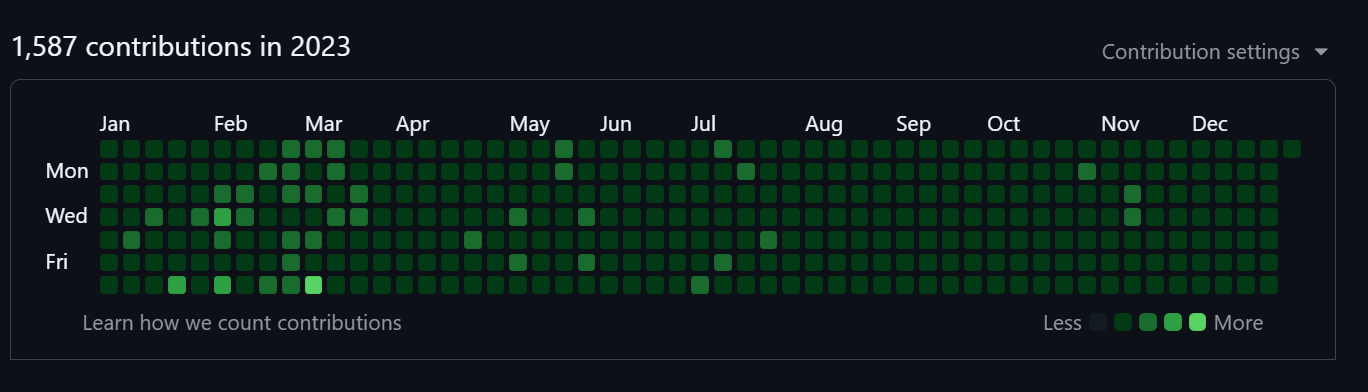
2024 is the strongest year of the entire set. This is the first time since before the coma where I could fully pour myself into a project with the same intensity that I used to have. The daily squares are brighter because I was brighter. I could concentrate again. My passion for programming finally had room to breathe.
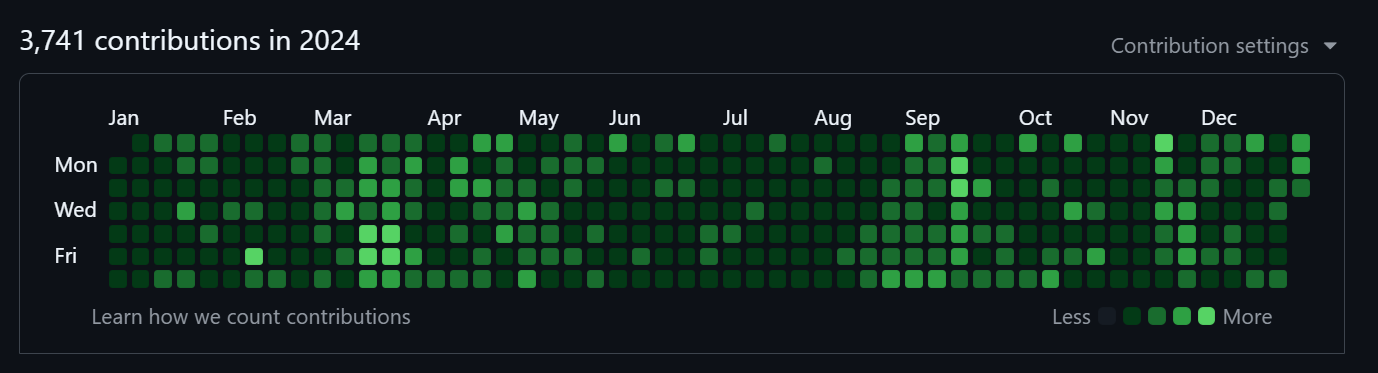
And now 2025. This chart shows balance. Not as intense as 2024, but steadier in a different way. This is the year where I found a rhythm that works with how my brain is now. I am not fighting myself anymore. I am creating in a way that feels natural again. Every square here is a step forward, not a step out of a hole.
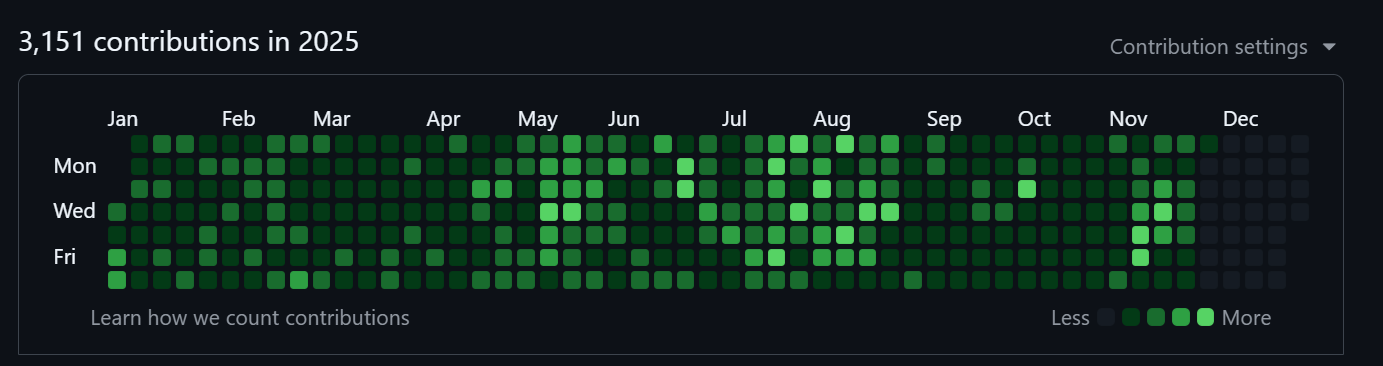
When I look at these calendars together, I can see the exact moment my mind started healing, the exact moment my focus returned, and the exact moment I became capable of building real software again. This is what recovery looks like when programming is part of your identity. It does not happen all at once. It happens one commit at a time.